The summer slowdown gives businesses a rare chance to complete electrical upgrades without the usual pressure of daily operations. In warehouses, offices, schools, leisure centres and sports venues, lower occupancy creates space to carry out work that is difficult, risky or disruptive during normal trading hours.
The slowdown period can reduce electrical risk, cut wasted energy and prepare a building for future demand. Used poorly, it becomes a rushed maintenance window with too many contractors, unclear isolation plans and avoidable delays when the site needs to reopen.
The key is to treat summer slowdown electrical upgrades as an operational project, not just an electrical job.
Start with a pre-slowdown electrical review
A good plan starts well before the slowdown begins. Facilities teams should review the current condition of the electrical installation, including recent fixed wire testing, thermal imaging, maintenance logs, fault records and energy data. This helps identify overloaded boards, ageing switchgear, nuisance tripping, poor access, damaged equipment and circuits that are close to capacity.
This early review is important because the slowdown window should be used for work that genuinely needs reduced occupancy or power isolation. Surveys, specification work, ordering materials and access planning should happen in advance. Once the slowdown starts, the focus should be on safe delivery, testing and returning systems to service.
Plan the work in clear stages
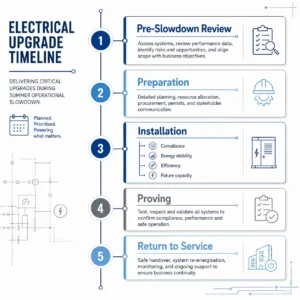
The most effective approach is to divide the project into three stages: preparation, installation and proving.
Preparation includes surveys, design checks, risk assessments, method statements, permit planning, temporary power design and communication with everyone affected. Installation covers the physical upgrade work, including isolations, replacements, new cabling, containment, metering and controls. Proving means inspection, testing, commissioning, certification and checking that systems operate properly before the building returns to normal use.
Many businesses lose valuable time because they start discovering issues once contractors are already on site. That is when missing parts, unclear cable routes, unidentified circuits and access problems become expensive. A proper pre slowdown survey reduces that risk.
Prioritise compliance and electrical resilience
The first priority during any summer slowdown should be compliance and resilience. This may include replacing old distribution boards, upgrading protective devices, improving earthing and bonding, correcting defects found during inspection and testing, and improving labelling.
These tasks may not look impressive on a capital plan, but they protect the building and reduce the chance of future downtime. They also give the business a stronger base for future upgrades, especially where electrical demand is expected to rise.
Use the slowdown to improve energy visibility
The second priority should be energy visibility. Many commercial sites still rely on main meter readings and monthly bills. That is not enough detail to manage energy use properly.
Summer slowdown electrical upgrades are an ideal time to install sub metering across key areas such as warehouse zones, tenant spaces, HVAC plant, lighting circuits, EV chargers, kitchens, server rooms and specialist equipment.
Once sub metering is in place, the business can see where energy is being used, when demand peaks occur and which systems are running outside working hours. This gives facilities teams practical evidence for future decisions rather than relying on estimates.
Complete efficiency upgrades while the building is quieter
The third priority should be efficiency. LED lighting upgrades, lighting controls, occupancy sensors, power factor correction, control panel improvements and variable speed drive upgrades can often be delivered more easily when buildings are quiet.
In offices, work can be phased floor by floor. In warehouses, it can be planned around racking aisles, loading bays and cold stores. In stadiums, it can be aligned with fixture lists, concerts and summer events.
Prepare for future electrical demand
The fourth priority is future capacity. Electrical demand is increasing across many commercial buildings. EV charging, heat pumps, solar PV, battery storage, automation, catering equipment, data systems and smart building technology all add pressure to existing infrastructure.
The summer slowdown is a strong opportunity to create spare capacity, install new containment, add metering points and prepare switchgear for future loads.
Protect essential systems during the upgrade
Operational continuity must sit at the centre of the plan. Before work begins, the business should decide what must stay live, what can be isolated and what needs temporary supply.
A warehouse may need refrigeration, fire alarms, access control, CCTV, IT systems and battery charging kept online. An office may need comms rooms, lifts, tenant services and life safety systems protected. A stadium may need pitch systems, emergency lighting, broadcast facilities, security systems and ticketing infrastructure available even when most areas are closed.
Do not leave temporary power to the last minute
Temporary power should never be an afterthought. Generators, temporary distribution boards, UPS systems and staged changeovers need proper design.
The plan should cover load calculations, cable routes, fuel, weather protection, security, fire risk and emergency response. A poorly planned temporary supply can create more risk than the upgrade itself.
Keep everyone informed before, during and after the slowdown
Clear communication also prevents disruption. Site users need to know which areas are affected, when power will be unavailable and who has authority to approve changes.
Operations teams need slowdown and restart instructions for equipment and IT teams need notice of any impact on networks, servers or access systems. Security and cleaning teams should also be included, as they are often on site when faults or access issues appear.
Prove every system before reopening
The return to service stage is where many projects fall short. Testing should not be treated as a final formality.
Every upgraded system should be inspected, tested, commissioned and documented before normal operations resume. Metering systems should be checked against real loads. Dashboards should be set up. Alerts should be tested. Baseline data should be recorded so the client can compare normal use after reopening.
Turn the slowdown into a smarter electrical strategy
For electrical contractors like Powercor, this creates a clear opportunity to offer more value. Clients need slowdown planning, risk control, temporary power, metering strategy, commissioning and post project reporting.
Contractors that can manage the whole process will stand out from those who simply price the visible work.
The summer slowdown is one of the best times to complete electrical upgrades without disrupting operations, but only if the work is planned around the way the building actually runs. Start early, identify the weak points, protect essential systems, meter the right loads and prove everything before reopening.
That is how businesses turn a short slowdown into safer, smarter and more efficient electrical infrastructure.