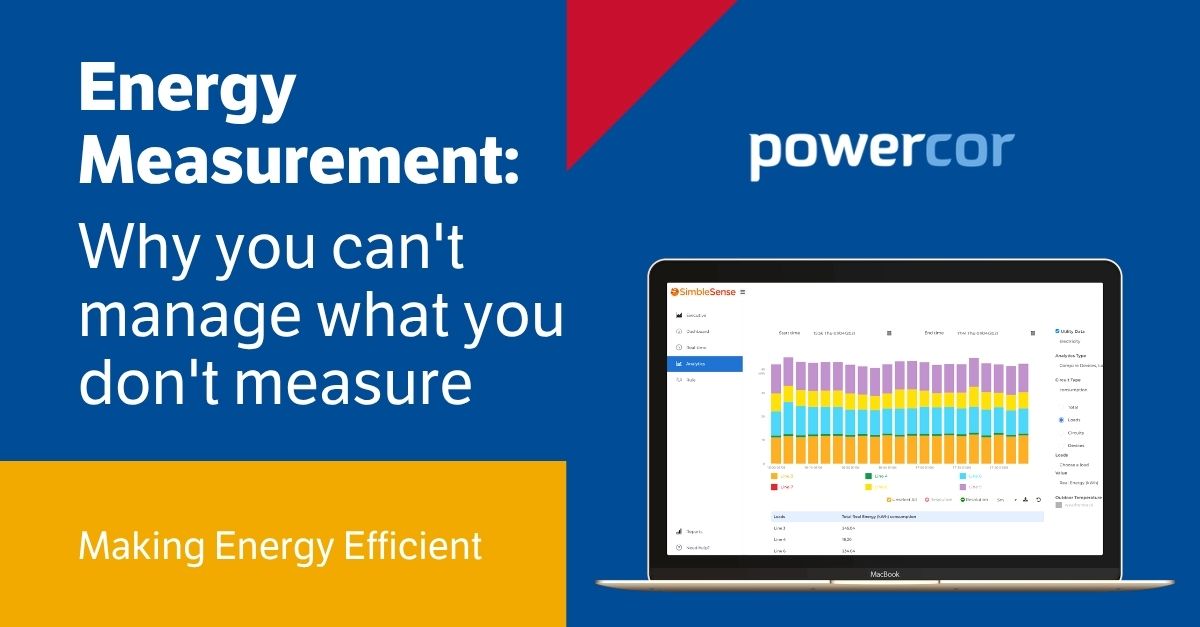
Energy Measurement is the foundation of every credible net zero plan. Without it, you can only guess the level of energy you are using.
While most commercial buildings have a meter, it doesn’t mean they understand their energy use. A single utility meter gives you a number. It tells you what the site has consumed and what the supplier will bill. It does not tell you which process, tenant, building zone, lighting circuit, HVAC system, charger, production line or item of plant is causing what level of demand.
That gap matters.
If a business is planning solar, battery storage, LED lighting, controls upgrades, ESOS evidence, SECR reporting or a net zero roadmap, poor data weakens every decision that follows. You can still make improvements, but you are making them with one eye closed.
For many organisations, the first shift is a mental one. Energy measurement is a compliance consideration, but it’s also an infrastructure one too. It’s the layer that turns energy from a monthly cost into something that can be sees, questioned and improved.
A meter is not an energy measurement strategy
There are three broad layers to understand.
A billing meter measures the total energy supplied to a site. It is important, but limited. It’s there for charging and settlement, not detailed operational insight.
Sub meters sit beneath the main meter. They measure defined areas, loads or systems. In a warehouse, that might mean lighting, heating, office areas, dock equipment and forklift charging. In a factory, it might mean compressed air, extraction, chillers, production lines and process equipment. In a sports stadium, it might mean floodlighting, catering, concourses, hospitality areas and event day loads.
Smart sensors add an additional layer of information and context. They can track temperature, occupancy, humidity, power quality, flow rates or equipment status. That matters because energy data alone tells you what happened whereas context helps explain why it happened.
This is where commercial energy metering installs become useful. The goal is not to collect data for the sake of it. The goal is to make energy use transparent so that better decisions can be taken.
What should a commercial site be measuring?
CIBSE TM39 is a useful reference point for building energy metering because it pushes the idea that metering should be designed around how a building actually uses energy. That sounds obvious, but many sites still rely on one incoming meter and a spreadsheet.
A practical system should separate the loads that matter most. At a minimum, many commercial sites should be able to see base load, operational load, heating, cooling, lighting, major plant, renewables, battery storage, EV charging and any significant tenant or departmental use.
The exact structure depends on the site. A cold store has different priorities from an office. A manufacturing facility has different priorities from a sports venue. The principle is the same: measure the areas where energy use is large, variable or strategically important.
Good sub metering for business should help teams answer better questions, not simply produce prettier charts.
Five questions a proper energy measurement system should answer
A standard utility meter answers one just question….how much energy did we use?
A good energy measurement system answers the questions that help people act.
- Where is energy being used? This separates real operational demand from avoidable waste.
- When is it being used? Half hourly data can reveal night time load, weekend consumption and demand spikes that drive cost.
- What is driving the pattern? Linking energy data to occupancy, production schedules, weather or event calendars helps explain unusual movement.
- Did the upgrade work? This is vital when proving the impact of LED Lighting & Controls, HVAC changes, controls optimisation or Solar & Battery Storage.
- Where should the next investment go? Energy measurement gives finance, facilities and sustainability teams evidence they can use.
This is why metering and measuring energy should sit near the start of the energy roadmap. Without it, solar sizing is weaker. Battery modelling is less certain. Lighting savings are harder to prove. ESG reporting leans on estimates. Maintenance teams miss early warnings.
What often appears in the first 90 days
The first savings rarely come from a major capital project. They usually come from visibility.
Once a site starts looking properly, familiar issues appear quickly. Lighting is left on after hours. Heating starts too early. Cooling runs against heating. Compressors leak. Pumps run continuously. Refrigeration set points drift. Office equipment keeps drawing power through the night. Weekend demand looks suspiciously close to weekday demand.
None of this is glamorous. It is often basic. That is exactly why it matters.
The first 90 days should usually focus on three things: build the baseline, find abnormal use and correct the obvious controls issues. This creates fast wins and gives the business confidence that the data is worth using.
It also creates the evidence needed for bigger work. A factory considering a lighting upgrade can build a stronger business case when it understands operating hours, load profile and control behaviour. That links directly to projects such as Unlocking the full benefit from your factory lighting.
Integration is where energy measurement becomes useful
Energy data has to go somewhere useful.
For facilities teams, that may be the building management system. Metering data can sit alongside schedules, alarms and plant performance, which makes it easier to spot problems and fix them.
For sustainability teams, it may feed ESG dashboards, carbon reporting and ESG policy commitments like the ones we have here at Powercor. For finance teams, it may support cost allocation by department, tenant, process or building.
For organisations working towards ISO 50001, energy measurement supports baselines, energy performance indicators and continual improvement. It also improves the credibility of reporting because claims can be backed by measured evidence rather than broad assumptions.
This is the point many businesses miss. Energy measurement is not separate from net zero. It is one of the foundations that makes net zero planning credible.
A sensible rollout for sites with limited capex
A good energy measurement strategy does not need to start with a full site overhaul.
Start with what already exists. Review main meter data, half hourly records, tariff details, operating hours and known major loads. Clean up the basics before adding more hardware.
Then prioritise the areas with the strongest business case. That may be HVAC, lighting, production equipment, compressed air, EV charging, solar generation, battery storage or tenant supplies. Meter the loads that are expensive, uncertain or important to future investment.
Next, make the data visible. A dashboard only works if someone uses it. Agree who owns the data, what gets reviewed and what triggers action. Weekly review at the beginning is often more valuable than a complex system no one checks.
Then connect insight to action. Adjust controls. Repair faults. Challenge out of hours demand. Validate retrofit savings. Improve reports. Build sharper business cases.
Energy measurement is not the destination. It is the foundation that makes every energy decision more reliable.
For commercial sites serious about cost, carbon and net zero, the message is blunt: measure first, or keep guessing.