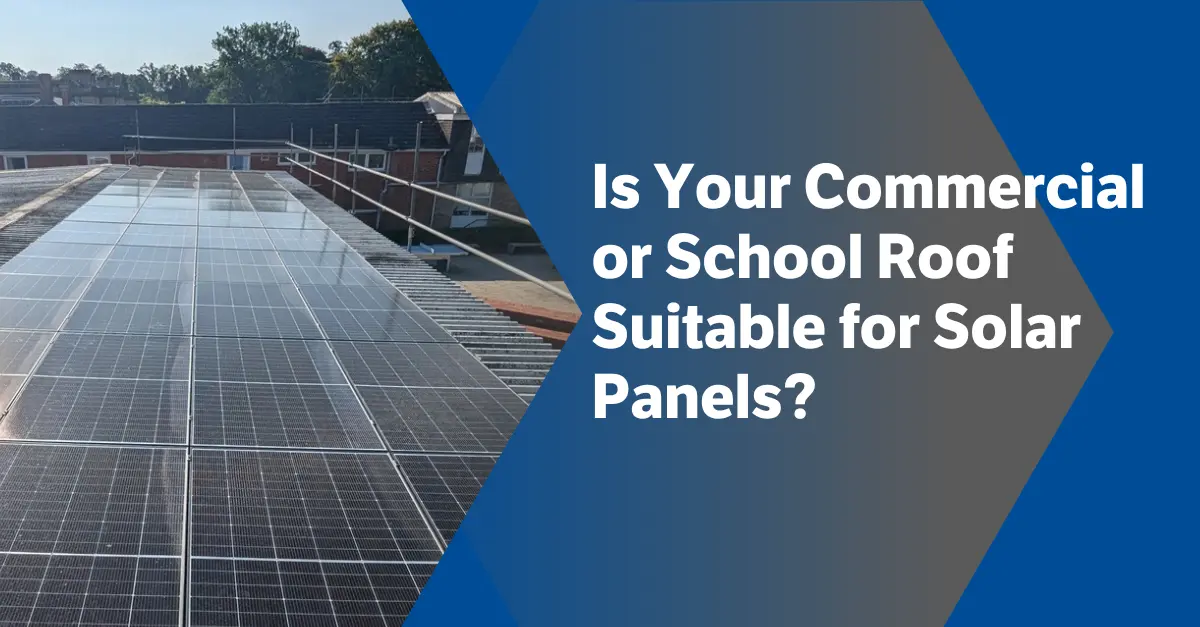
A large, unused roof can make solar PV look like an obvious choice for a business or school. Warehouses, offices, schools, colleges and sports facilities often have substantial roof areas that could potentially generate electricity for use on site.
But how do you know whether your roof is actually suitable for solar panels?
Size alone does not provide the answer.
Data reported by Insurance Times in August 2026 found that 35% of commercial rooftops assessed could not safely support solar panels without remedial work or alterations. The findings came from 575 structural feasibility surveys of commercial properties.
For any organisation considering commercial solar, the building needs to be assessed before the solar array is designed.
Can your roof support solar panels?
One of the first questions is whether the existing roof structure can safely accommodate the loads created by a solar PV installation.
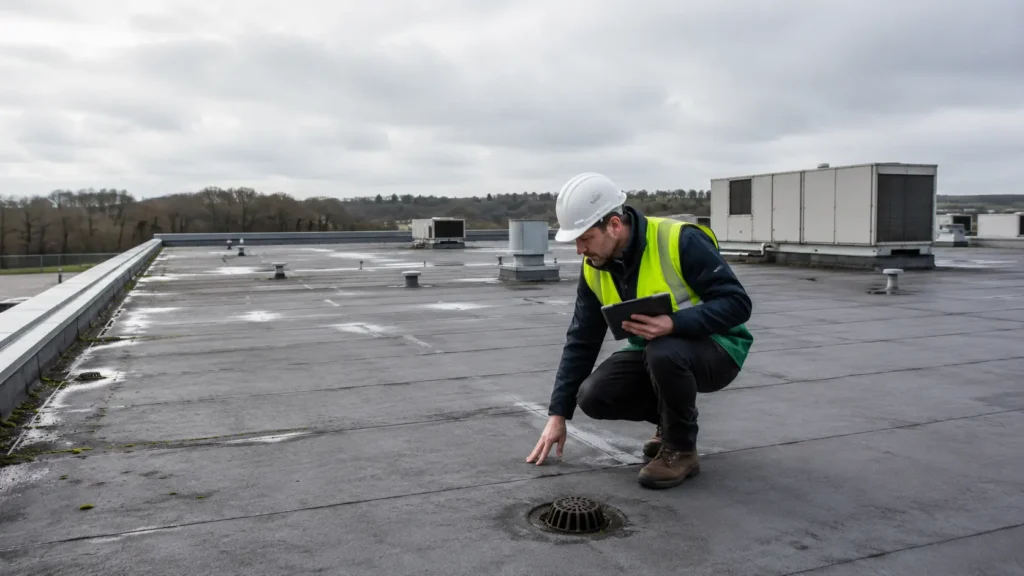
Solar panels, mounting equipment and associated components all add permanent weight. Some flat roof systems also require ballast to hold the array securely in place.
Wind creates additional forces that must be accounted for too.
MCS guidance states that where a ballasted solar system is installed on a flat roof, a qualified structural engineer should confirm that the roof can withstand the loads created by the solar system and its ballast. Its guidance for metal roofs also requires consideration of how loads and wind forces are transferred through the roof covering to the main structure.
For schools, current Department for Education guidance recommends assessing structural integrity when planning photovoltaic installations. It also advises education estates to consider roof condition, orientation and remaining lifespan.
This means a roof assessment should happen early in the solar project, rather than once panels and equipment have already been specified.
Does the condition and the age of the roof matter?
Yes. Roof condition can have a significant effect on whether a solar installation makes financial and practical sense.
Solar PV is intended to remain in place for many years. Installing panels over a roof covering that is approaching the end of its useful life could mean removing part or all of the array when roof repairs become necessary.
Signs of deterioration, water ingress, corrosion, damaged roof sheets or problems with the supporting structure should therefore be identified before installation.
For schools and colleges, the Department for Education currently states that certain applications for solar panels will not be approved where the roof condition is poor.
Education settings also need to be aware of Reinforced Autoclaved Aerated Concrete, known as RAAC. Government guidance notes that RAAC panels may be present in roofs of buildings constructed or modified between the 1950s and 1990. Any known or suspected structural issue needs to be understood before additional rooftop equipment is considered.
What type of commercial roofs are suitable for solar panels?
Many common commercial and educational roof types can accommodate solar PV. The mounting method and structural assessment will differ according to the construction of the building.
Profiled metal roofs
Profiled metal roofing is common on warehouses, factories, industrial units, sports centres and distribution facilities.
Large roof areas and relatively few obstructions can make these buildings attractive for commercial solar.
The condition and thickness of the roof sheets need to be considered, together with their connection to the structure beneath. MCS guidance specifically requires metal roof fixings to be capable of transferring the additional loads created by the solar system.
Standing seam roofs
Standing seam metal roofs can work particularly well with solar PV.
Suitable mounting systems can attach to the raised seams, which may avoid penetrating the roof covering itself.
The roof still needs to be checked for structural capacity, condition and compatibility with the mounting system.
Flat roofs
Flat roofs are common on schools, offices, retail units and many commercial buildings.
They offer considerable flexibility because panels can be positioned on mounting frames to achieve an appropriate angle and orientation.
The system may use ballast or mechanical fixings. With ballasted systems, the additional weight needs careful consideration. Drainage, waterproof membranes, existing roof plant and safe maintenance access must also remain part of the design.
Pitched tiled roofs
Pitched tiled roofs are frequently found on schools, offices and smaller commercial premises.
Solar panels can usually be attached to the roof structure using suitable mounting brackets. The tiles themselves should not be expected to support the array.
Roof condition is especially important. Damaged tiles, ageing battens or problems with rafters may need attention before installation.
Slate roofs
Solar can also be installed on slate roofs, although the installation needs greater care because slate can be fragile.
A suitable fixing system should transfer the loads into the supporting roof structure while maintaining the weather protection of the building.
MCS roof fixing standards require solar mounting arrangements to maintain the weather performance of the roof and avoid damaging fragile coverings through unsuitable point loads.
Does a solar panel need to face south?
No.
A south facing roof can provide strong generation, but east and west facing roofs can also be suitable for commercial solar.
For a business or school, the more important question is often when electricity is being used.
A building with significant electricity demand throughout the working day may be able to consume a large proportion of the solar electricity as it is generated. An east and west array can also spread generation across a wider part of the day.
The design should therefore consider the building’s actual electricity consumption alongside roof orientation.
What about shading and roof obstructions?
Shading can reduce the electricity generated by solar panels.
Potential sources include trees, nearby buildings, parapet walls, air conditioning equipment, ventilation systems and other rooftop plant.
The usable roof area may therefore be considerably smaller than the total roof area shown on a drawing or satellite image.
Maintenance access must also be considered. Engineers still need safe access to roof plant, drainage systems and the solar installation itself.
For schools and colleges, Department for Education guidance specifically recommends planning safe and practical access for future cleaning and servicing.
The electrical infrastructure matters too.
A suitable roof is only part of a successful commercial solar project.
At Powercor, we also look at the building’s electrical infrastructure and energy use.
That includes understanding when electricity is consumed, existing distribution equipment, metering arrangements, connection capacity and where the solar system can connect safely into the installation.
This information helps determine what size system is appropriate for the site.
There is little value in simply filling every available square metre of roof with panels without understanding what happens to the electricity they produce.
Start with the building, not the panels
The 35% figure reported by Insurance Times makes an important point. A large commercial roof does not automatically make a building suitable for solar.
Roof condition, structural capacity, construction, orientation, shading and access all need to be considered. The building’s electrical infrastructure and energy profile should then inform the size and design of the system.
Where remedial work is required, finding that out at the beginning gives the organisation the opportunity to address it as part of the wider project.
At Powercor, that assessment comes before installation.
How can Powercor help?
If you are considering solar panels for a school, warehouse, office, sports facility or other commercial building, we can assess the roof, electrical infrastructure and energy requirements before developing a solar PV system suited to the site.