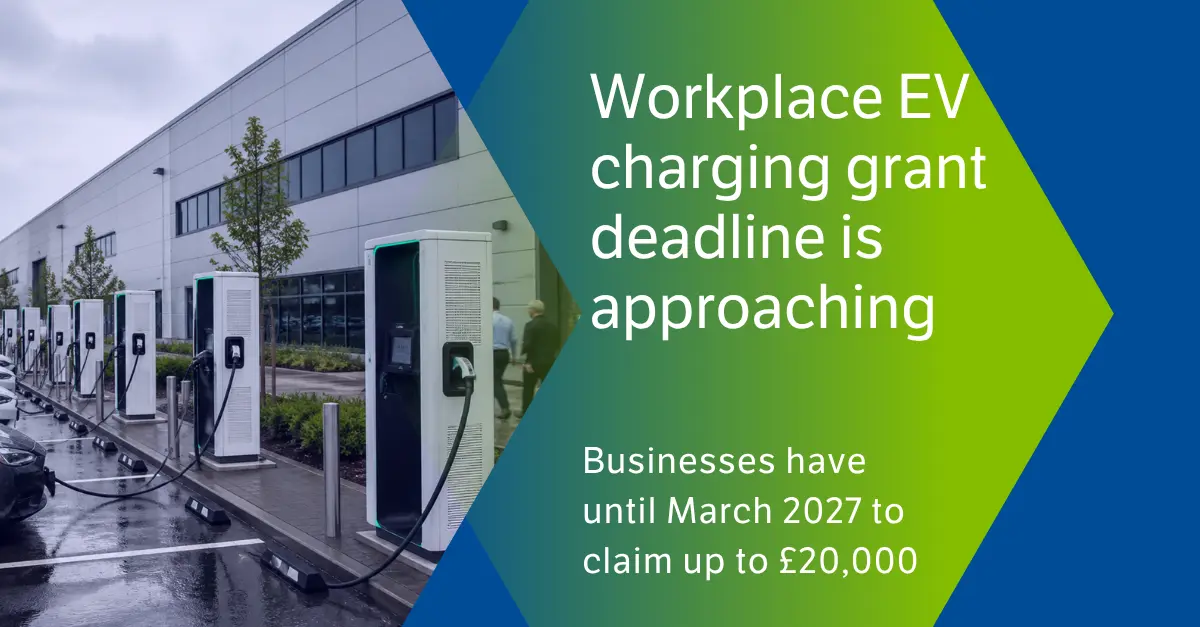
Businesses planning to install electric vehicle charging points at their premises have a limited opportunity to benefit from government funding, with the Workplace EV Charging grant scheduled to close on 31 March 2027.
The scheme offers financial support towards the installation of workplace EV charge points, helping businesses prepare for the growing demand for electric vehicles while reducing the upfront cost of charging infrastructure.
With the grant increased to £500 per socket in April 2026, eligible organisations could receive up to £20,000 towards their installation.
However, installing EV charging infrastructure requires careful planning. For businesses considering making the move, now is a good time to assess their requirements and understand what’s involved before the scheme closes.
What is the Workplace Charging Scheme?
The Workplace Charging Scheme (WCS) is a government initiative administered by the Office for Zero Emission Vehicles (OZEV), designed to help organisations with the cost of purchasing and installing electric vehicle charge points.
Following changes introduced in April 2026, the scheme now provides:
- Up to £500 per charging socket, increased from £350.
- Funding covering up to 75% of eligible purchase and installation costs.
- Support for a maximum of 40 sockets per applicant across their sites.
- A potential £20,000 in total grant support, subject to eligibility and installation costs.
The scheme is available to eligible businesses, charities and public sector organisations across the UK. A separate scheme with different funding rates is available for state funded education institutions.
With the government confirming the current extension as the final year, businesses should consider their options well ahead of the March 2027 deadline.
Why workplace EV charging is becoming increasingly important
Commercial EV charging solutions are becoming a priority for businesses. As more organisations introduce electric vehicles into their fleets and employees make the switch to electric cars, access to reliable workplace charging is becoming an important consideration.
For businesses operating offices, warehouses, industrial premises and commercial facilities, installing EV charge points can offer several practical benefits.
- Supporting electric company fleets
Businesses transitioning to electric vehicles need dependable charging facilities that fit their operating schedules. Workplace charging provides greater control over when vehicles are charged and helps reduce reliance on public charging infrastructure.
- Providing facilities for employees
Offering charging facilities at work can make electric vehicle ownership more convenient for employees, particularly those without access to home charging.
- Supporting sustainability objectives
Workplace EV charging can form part of a wider carbon reduction strategy, especially when combined with renewable electricity generation and effective energy management.
However, choosing the right charging infrastructure involves more than deciding how many charge points to install.
What should businesses consider before installing EV charge points?

A successful workplace charging installation starts with understanding the building’s existing electrical infrastructure and how the charge points will be used.
There are several important questions to address before committing to a project.
- Does your building have sufficient electrical capacity?
EV charging can place significant additional demand on a building’s electrical supply, particularly when multiple vehicles are charging simultaneously.
An electrical assessment can establish whether the existing infrastructure can support the proposed installation or whether upgrades may be required.
Businesses should also consider their future requirements. Installing infrastructure that can accommodate additional charge points later may help avoid unnecessary disruption and expense.
- How many chargers do you actually need?
The right number of charging sockets will depend on factors including fleet size, employee demand, parking arrangements and how long vehicles remain on site.
A business with vehicles parked overnight may have different requirements from an office where employees typically park for eight hours during the working day.
Understanding these usage patterns will help determine the most appropriate charging equipment and capacity.
- Could intelligent load management reduce costs?
Installing multiple charge points does not necessarily mean every vehicle needs to charge at full power simultaneously.
Intelligent load management systems can distribute available electrical capacity between chargers according to demand.
This helps prevent unnecessary strain on the building’s electrical supply and may reduce the need for costly infrastructure upgrades.
When combined with energy monitoring, businesses can also gain clearer visibility of charging consumption and operating costs.
Combining EV charging with solar and battery storage
For organisations looking to improve energy efficiency, workplace EV charging presents an opportunity to consider how electricity is generated, stored and consumed across their premises.
Commercial solar PV and battery storage systems can generate electricity during daylight hours, potentially supplying some of the energy required for vehicles charging on site.
Where appropriate, battery storage can capture surplus solar generation and make it available at other times.
This combination may help businesses reduce their reliance on grid electricity and manage periods of higher energy demand.
However, the benefits depend on factors such as solar generation, vehicle charging patterns, available storage capacity and electricity tariffs.
At Powercor, we believe EV charging should be considered alongside a building’s wider electrical infrastructure and energy strategy rather than as an isolated installation.
By bringing together expertise in EV charging, solar PV, battery storage and energy monitoring, we can help organisations explore solutions suited to their operational needs.
Why businesses should start planning before the deadline
Although the Workplace EV Charging grant is currently available until 31 March 2027, there are several stages to consider before installation.
These may include:
- assessing electrical capacity
- determining charging requirements
- obtaining quotations
- checking eligibility and arranging installation.
Businesses must apply for the grant before installation and use an OZEV authorised installer and eligible equipment.
Following approval, a voucher is issued, normally valid for 180 days. The installation and grant claim must be completed within the voucher’s validity period.
Leaving the process until the final weeks of the scheme could limit the time available to assess the site properly and put suitable arrangements in place.
An early assessment gives businesses an opportunity to plan their infrastructure, understand potential costs and determine whether the available funding could support their project.
Plan your workplace EV charging with Powercor
With over 25 years of electrical engineering experience, Powercor supports commercial organisations with electrical infrastructure upgrades and energy efficiency projects.
Our EV charge point services can help businesses assess their charging requirements and consider how installations fit alongside existing electrical systems, future demand and wider sustainability objectives.
Whether you’re exploring your first workplace charging installation or planning to expand facilities across several sites, early preparation can make the process more straightforward.
The Workplace EV Charging grant is currently due to close on 31 March 2027. If EV charging is part of your business plans, now is the time to start the conversation.
Find out more about Powercor’s EV charge point services
or contact our team on 01932 839890 or sales@powercor.co.uk to discuss your requirements.